
major and minor scales piano pdf
Major and Minor Scales Piano: A Comprehensive Guide
Navigating the world of piano scales? This guide offers a deep dive into major and minor scales, utilizing readily available PDF resources for visual learners.
Discover how to identify scales easily!
Understanding the Basics of Scales
Scales are the fundamental building blocks of music, acting as melodic frameworks for compositions and improvisations. They represent a series of notes arranged in a specific order, defining a particular key and tonal character. Understanding scales is crucial for any pianist, enabling them to navigate the keyboard with confidence and comprehend musical structure.
Essentially, a scale provides the notes available for creating melodies and harmonies within a given key. Mastering scales isn’t just about memorization; it’s about internalizing the relationships between notes and developing a strong musical ear. PDF resources, like those available online (as seen in repositories like gemb0y/piano-scales and 0ranga/piano-scales), offer a visual approach to learning these patterns.
These visual aids are incredibly helpful for recognizing scale shapes and fingerings. They often display scales across the keyboard, highlighting the intervals and relationships between notes. Utilizing these PDFs alongside practical piano practice accelerates the learning process. Scales aren’t merely academic exercises; they unlock creativity and musical expression. They are the foundation upon which musical proficiency is built.
What are Major Scales?
Major scales evoke feelings of happiness, brightness, and stability. They are characterized by a specific pattern of whole and half steps, creating a cheerful and uplifting sound. Understanding this pattern is key to recognizing and playing major scales fluently on the piano.
These scales form the basis of much Western music, appearing frequently in popular songs, classical pieces, and jazz standards. PDF resources, such as those found on platforms like GitHub (gemb0y/piano-scales, 0ranga/piano-scales), visually represent major scale patterns across the keyboard, aiding in memorization and practical application.
These PDFs often include fingerings, making it easier to navigate the scales efficiently. Learning major scales isn’t just about playing the correct notes; it’s about understanding the intervals and their impact on the overall sound. The bright quality of a major scale stems from the major third interval within the scale. Mastering these scales provides a solid foundation for understanding harmony and chord progressions. They are essential for any aspiring pianist.
The Formula for Major Scales
The formula for constructing a major scale is Whole-Whole-Half-Whole-Whole-Whole-Half (W-W-H-W-W-W-H). This sequence dictates the intervals between each note in the scale. Starting on any note, apply this formula to determine the notes within that specific major scale. For example, starting on C, the C major scale is C-D-E-F-G-A-B-C.
Understanding this formula allows you to build major scales in any key without relying solely on memorization. PDF resources, often available online, visually demonstrate this formula applied to each key, showing the whole and half step relationships clearly. These PDFs can be incredibly helpful for visual learners;
Resources like those found on GitHub (gemb0y/piano-scales, 0ranga/piano-scales) often present this formula alongside keyboard diagrams. Practicing scales using this formula reinforces your understanding of musical intervals and strengthens your ability to transpose and improvise. It’s a fundamental concept for any pianist seeking a deeper understanding of music theory and practical application on the instrument.
Key Signatures in Major Scales
Key signatures indicate which notes are consistently sharp or flat throughout a piece of music, simplifying notation. In major scales, the number of sharps or flats corresponds directly to the scale’s key. For instance, G major has one sharp (F#), while F major has one flat (Bb). Learning to identify these key signatures is crucial for sight-reading and understanding musical structure.
PDF resources dedicated to piano scales often include charts displaying all major key signatures, visually associating each key with its corresponding sharps or flats. These charts are invaluable for quick reference and memorization. Resources like those available on platforms like GitHub (gemb0y/piano-scales, 0ranga/piano-scales) frequently incorporate these visual aids.
Understanding the Circle of Fifths is also beneficial, as it illustrates the relationship between keys and their key signatures. Utilizing PDF guides alongside the Circle of Fifths can accelerate your learning process. Mastering key signatures allows for smoother transitions between keys and a more profound comprehension of harmonic relationships within music.
What are Minor Scales?

Minor scales evoke a different emotional quality than major scales, often described as sadder or more melancholic. Unlike major scales, which have a bright and cheerful sound, minor scales possess a characteristic interval that creates a distinct mood. They are fundamental to a vast repertoire of music, spanning classical, jazz, and popular genres.
There isn’t just one minor scale; several types exist, each with a unique intervallic structure. These variations – natural, harmonic, and melodic – offer pianists a diverse palette of sounds. PDF resources focusing on piano scales typically dedicate sections to outlining these differences, often with clear diagrams.
Many PDF guides, like those found on platforms such as GitHub (gemb0y/piano-scales, 0ranga/piano-scales), present minor scales alongside their relative major counterparts, aiding in comprehension. Understanding the construction of minor scales is essential for composing, improvising, and analyzing music. Visual aids within these PDFs are incredibly helpful for memorizing the patterns.
Types of Minor Scales: Natural, Harmonic, and Melodic
The world of minor scales isn’t monolithic; it branches into three primary types: natural, harmonic, and melodic. Each variation alters specific notes to create a unique sonic texture. PDF resources dedicated to piano scales meticulously detail these differences, often using visual representations to aid learning.
The natural minor scale is the most basic, derived directly from the major scale’s relative minor. The harmonic minor scale raises the 7th degree, creating a stronger pull towards the tonic, a common feature in classical harmony. Finally, the melodic minor scale raises both the 6th and 7th degrees ascending, but reverts to the natural minor descending.
Many PDF charts, like those available through online repositories (e.g., GitHub projects such as gemb0y/piano-scales or 0ranga/piano-scales), illustrate these alterations clearly. These visual guides are invaluable for pianists. Mastering these three forms unlocks a deeper understanding of harmonic possibilities and allows for more expressive playing. PDFs often include exercises to practice each type.
The Formula for Natural Minor Scales
Understanding the formula for natural minor scales is crucial for piano players. It’s built upon whole and half steps, mirroring the structure of its relative major. The formula is: Whole – Half – Whole – Whole – Half – Whole – Whole. This translates to a specific interval pattern from the root note.
Compared to the major scale’s formula (Whole-Whole-Half-Whole-Whole-Whole-Half), the natural minor differs by a lowered 3rd, 6th, and 7th degree. PDF resources dedicated to piano scales often present this formula alongside visual diagrams, making it easier to grasp. These PDFs frequently highlight the relationship between the natural minor and its relative major.
For example, A natural minor consists of the notes A-B-C-D-E-F-G. Many online PDF charts (like those found on platforms like GitHub – gemb0y/piano-scales) demonstrate this visually. Utilizing these resources, alongside consistent practice, will solidify your understanding of the natural minor scale and its construction. Mastering this formula is foundational for improvisation and composition.
Relative Minor and Major Scales
The concept of relative minor and major scales is fundamental to understanding key relationships on the piano. Every major scale has a relative minor scale, and vice versa. They share the same key signature – meaning they utilize the same sharps or flats. To find the relative minor of a major scale, move down three semitones (half steps) from the root of the major scale.
For instance, C major has no sharps or flats. Its relative minor is A minor, also with no sharps or flats. PDF resources illustrating piano scales often visually demonstrate this relationship, showing both scales side-by-side with their shared key signature. These PDF charts (available on sites like GitHub – 0ranga/piano-scales) are invaluable for quick reference.
Understanding this connection simplifies learning scales and chords. Knowing the key signature of one scale instantly reveals the key signature of its relative counterpart. Many PDF practice materials focus on exercises that transition between relative minor and major scales, reinforcing this crucial musical link. This knowledge is essential for composing, improvising, and analyzing music.
Key Signatures in Minor Scales
Determining key signatures in minor scales requires understanding the three types: natural, harmonic, and melodic. While the natural minor scale shares the same key signature as its relative major, the harmonic and melodic minor scales introduce alterations. These alterations impact the key signature representation in PDF scale charts.
For example, A minor (natural) has no sharps or flats, mirroring C major. However, the A harmonic minor scale raises the 7th degree, often indicated in PDFs with a sharp symbol. Similarly, the A melodic minor scale raises both the 6th and 7th degrees ascending, and reverts to the natural minor descending – a detail clearly shown in comprehensive PDF resources.
PDF diagrams dedicated to minor scales often present all three variations alongside each other, highlighting the differences in accidentals. Resources like those found on GitHub (gemb0y/piano-scales) provide visual aids for quickly identifying key signatures. Mastering these nuances is crucial for accurate sight-reading and understanding the harmonic context of minor keys. Utilizing PDF practice sheets focusing on key signature identification is highly recommended.
Visual Aids: Scale Diagrams and Charts (PDF Resources)
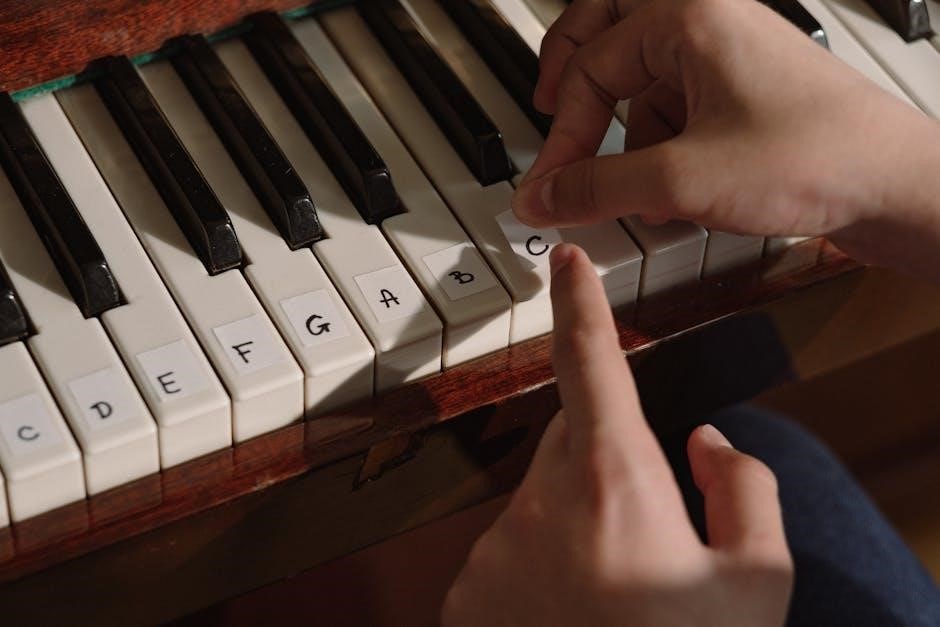
PDF scale diagrams and charts are invaluable tools for piano students. They visually represent fingerings, note positions, and key signatures, accelerating learning. Many free resources are available online, catering to different learning styles. GitHub repositories like gemb0y/piano-scales and 0ranga/piano-scales offer downloadable PDF posters designed for quick reference.
These PDFs typically display scales across the piano keyboard, color-coding notes for clarity. Some charts focus on individual scales, while others provide comprehensive overviews of all major and minor keys. Look for PDFs that include harmonic and melodic minor variations, as well as circle of fifths diagrams for contextual understanding.
When selecting PDF resources, prioritize those with clear notation and accurate fingerings. Printable scale charts allow for personalized practice, while interactive PDFs may offer audio examples. Utilizing these visual aids alongside traditional sheet music enhances comprehension and memorization. Remember to explore various PDF options to find what best suits your learning preferences.
Practicing Major Scales on Piano
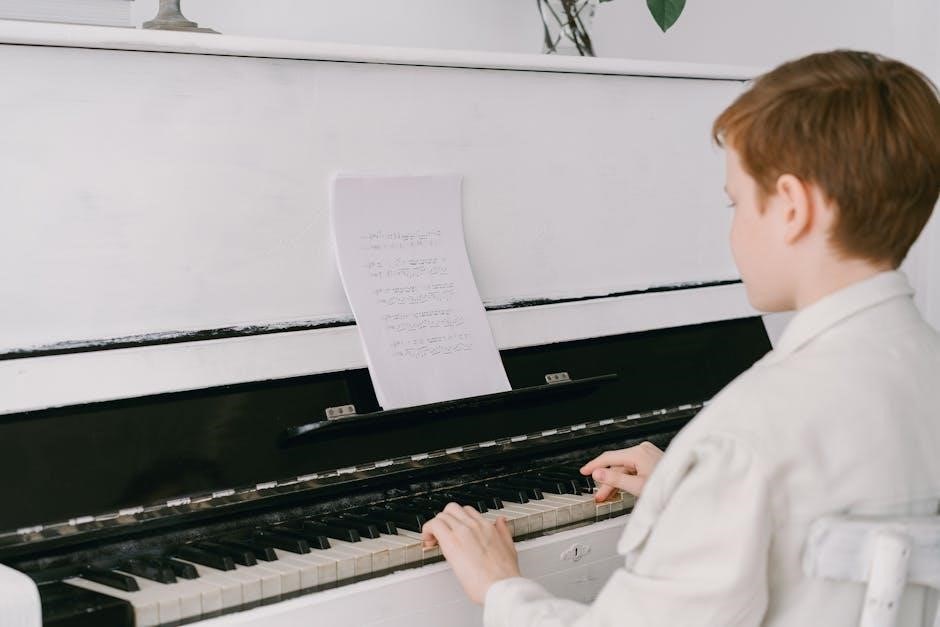
Consistent practice is key to mastering major scales. Begin slowly, focusing on evenness of tone and accurate fingerings. Utilize PDF scale charts as visual guides, referencing fingerings while playing. Start with C major, as it has no sharps or flats, then progressively introduce scales with increasing key signatures.
Practice scales hands separately, then together. Vary your rhythm – play scales staccato, legato, and with dotted rhythms. Incorporate different articulations to develop finger dexterity and musicality. Utilize the PDF resources to visualize the scale patterns across the keyboard, reinforcing muscle memory.
Don’t just ascend and descend; practice scales in thirds, fourths, and sixths. This expands your understanding of intervals and chord construction. Regularly review previously learned scales to maintain proficiency. Supplement your practice with PDF-based exercises focusing on specific technical challenges. Remember, quality practice trumps quantity!
Practicing Minor Scales on Piano
Mastering minor scales requires understanding their variations – natural, harmonic, and melodic; Begin with the natural minor scale, utilizing PDF charts to visualize the pattern and corresponding fingerings. Pay close attention to the altered notes in harmonic and melodic minor scales, as these differ from the natural minor.
Practice each minor scale form (natural, harmonic, melodic) separately, then combine them. Focus on smooth transitions between the variations, especially the raised 7th in harmonic minor and the raised 6th and 7th in melodic minor (ascending). PDF resources can be invaluable for comparing and contrasting these forms.
Explore relative minor scales alongside their major counterparts, using PDF diagrams to identify the shared notes and differing intervals. Practice scales in various keys, gradually increasing the complexity. Incorporate arpeggios and chord progressions based on the minor scales to solidify your understanding and musical application. Consistent, focused practice is crucial for fluency.
Common Mistakes to Avoid When Learning Scales
Learning scales can be tricky! A frequent error is neglecting proper fingering. Always refer to PDF scale charts for correct fingerings, ensuring smooth transitions and avoiding awkward hand positions. Don’t rush the process; prioritize accuracy over speed initially.
Another common mistake is memorizing patterns without understanding the underlying theory. Utilize PDF resources that explain the formulas for major and minor scales, and actively apply this knowledge. Avoid simply “playing” the scale; instead, “think” the intervals and key signatures.
Many learners struggle with differentiating between minor scale types (natural, harmonic, melodic). PDF comparisons are essential here; Also, failing to practice scales in all keys is a significant oversight. Expand your repertoire gradually, using PDF guides to navigate new key signatures. Finally, don’t isolate scales; connect them to chords and musical pieces for practical application.
Resources for Printable Piano Scale PDFs

Need readily available scale references? Several online platforms offer free, printable piano scale PDFs. Websites like 8notes.com provide comprehensive scale charts for both major and minor keys, including fingerings and key signatures. MusicTheory.net also offers downloadable PDF resources focusing on scale construction and theory.
For visually oriented learners, consider the resources available on gemb0y/piano-scales and 0ranga/piano-scales on platforms like GitHub. These often present scales in a poster-like format, aiding quick identification. Teoria.com provides interactive exercises alongside downloadable PDF scale diagrams.
Additionally, many piano method books include PDF supplements with scale exercises. Search for “printable piano scales PDF” to uncover a wealth of options. Remember to choose resources that clearly display fingerings and key signatures, and cater to your learning style. Utilizing these PDF tools will accelerate your scale mastery!
Applying Scales to Chord Progressions and Improvisation
Beyond rote memorization, understanding how scales relate to chords unlocks musical expression. Once comfortable with major and minor scales – referencing your piano scale PDF – begin analyzing common chord progressions. Identify the scale that naturally fits each progression, allowing for melodic improvisation.
For example, a C major chord progression (C-G-Am-F) utilizes the C major scale. Experiment with notes from this scale over the chords, focusing on chord tones for stability and passing tones for color. Similarly, an A minor progression (Am-F-C-G) draws from the A natural minor scale.
Utilize your PDF as a guide to visualize scale degrees and their corresponding chord tones. Explore different scale variations (harmonic, melodic) to add complexity. Improvisation becomes intuitive when you internalize these connections. Remember, scales aren’t just exercises; they’re the building blocks of melodies and harmonies!